
Remember that feeling in early 2010 when "the cloud" was still this nebulous, slightly intimidating concept, and smartphones were just starting to feel truly indispensable? Or perhaps you recall the debates around Agile adoption a decade prior? The tech world, my friends, never truly slows down. It morphs, it evolves, it accelerates. And if you’re anything like me – a curious mind perpetually trying to peer around the corner into the next wave – then 2026 isn't some distant science fiction novel; it's practically tomorrow.
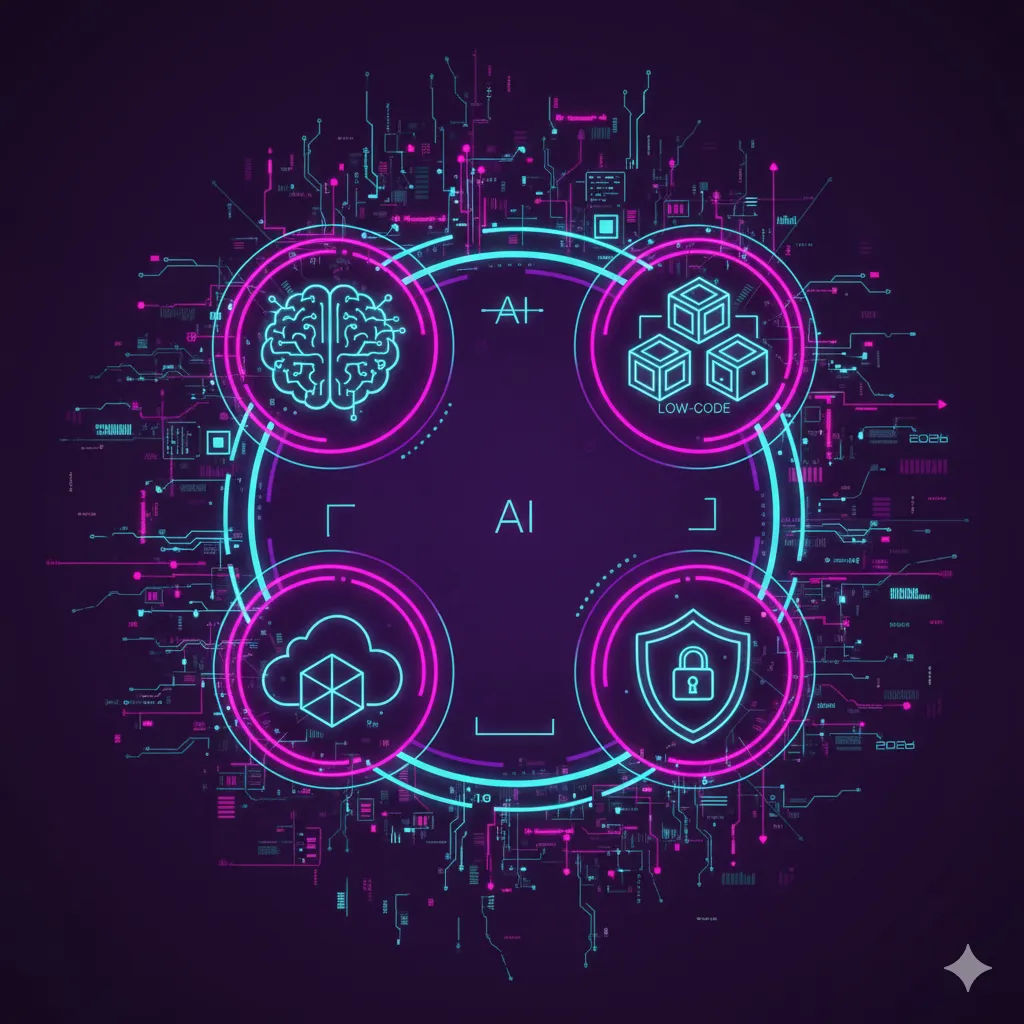
We’re living through an extraordinary period of convergence. Artificial Intelligence, once a niche academic pursuit, is now generating code and conversations. Low-code platforms, previously scoffed at by many traditional developers, are proving their mettle in accelerating enterprise innovation. Cloud infrastructure continues its relentless expansion, becoming the omnipresent fabric of our digital lives, while security, as ever, remains the critical, ever-evolving guardian.
These aren’t just buzzwords; they’re tectonic shifts. They’re reshaping how we design, develop, deploy, and defend software. So, grab a coffee – or your beverage of choice – and let's delve into what I believe are the top 10 software development trends that will define our craft by 2026. This isn't just about what's new; it's about what's enduring, what's gaining critical momentum, and what truly warrants our attention as we build the future.
1. AI-Native Development: Building With Intelligence
For years, we've integrated AI into our applications. We built recommendation engines, fraud detection systems, and natural language processing features. But 2026 will see a significant shift towards truly AI-native architectures. This isn't just about adding an AI component; it's about designing systems where AI is an intrinsic, foundational part of their operating DNA.
Imagine applications that don't just react but proactively learn, optimize, and even self-heal using embedded AI models. Think intelligent resource allocation in cloud environments that goes beyond simple auto-scaling, predicting demand patterns with uncanny accuracy. Or backend systems that detect anomalies, not just through rules, but by understanding complex behavioral patterns, often without human intervention. This requires a fundamental rethink of how we design data pipelines, how we manage model lifecycles, and how we integrate AI governance directly into our system architectures from day one. Developers will need to become adept not just at consuming AI APIs, but at structuring systems that are inherently intelligent, adaptive, and perhaps even somewhat autonomous. It’s a fascinating, slightly daunting, but ultimately empowering paradigm shift.
2. The Rise of Generative AI in the Dev Lifecycle
If you haven't yet experimented with GitHub Copilot or similar tools, you're missing out on a taste of what's to come. 2026 will cement the role of generative AI as an indispensable development assistant. We're moving beyond simple code completion. These tools are evolving into co-creators, capable of generating entire functions, suggesting optimal data structures, drafting comprehensive test suites, and even turning natural language prompts into working prototypes.
This isn't just a productivity hack; it's a profound change in the coding experience. It will free developers from repetitive boilerplate, allowing them to focus on higher-level architectural decisions, complex problem-solving, and creative innovation. The challenge, of course, lies in effective prompting, critical review of generated code for security and performance, and maintaining a deep understanding of the underlying logic. But the days of mindlessly typing out getter/setter methods or basic CRUD operations are rapidly receding. We’ll be less typists, more architects and editors, leveraging AI to amplify our output and explore design possibilities far faster than before. It’s a tool that demands a new kind of intelligence from us: not just coding, but intelligent collaboration with an AI.
3. Low-Code/No-Code for the Professional Developer
For years, the low-code/no-code (LCNC) movement was often framed as a threat to professional developers, or at best, a tool for "citizen developers" to build simple departmental apps. I've heard the skepticism, believe me. But by 2026, I firmly believe we’ll see LCNC platforms adopted and leveraged strategically by professional developers themselves, often as a core component of enterprise architecture.
Why the shift? Because LCNC has matured. It’s no longer about drag-and-drop forms; it's about sophisticated platforms that enable rapid prototyping, accelerate integration of disparate systems, and abstract away much of the boilerplate infrastructure code. Professional developers will use LCNC for what it’s good at: managing workflows, orchestrating microservices, automating business processes, and building UI layers that integrate with custom-coded backend logic. It’s about creating a harmonious ecosystem where custom code handles complexity and unique IP, while LCNC handles speed and standardization. This allows teams to deliver faster, reduce technical debt in common areas, and focus their engineering prowess where it truly matters. It’s about strategic leverage, not replacement.
4. Platform Engineering: The Internal Developer Platform (IDP)
The rise of cloud-native development brought immense power and flexibility, but also a staggering increase in complexity. DevOps was a step, but often devolved into "you build it, you run it," leaving feature teams swamped with operational burdens. Enter Platform Engineering, and by 2026, its flagship, the Internal Developer Platform (IDP), will be a cornerstone of high-performing organizations.
An IDP isn't just a collection of tools; it's a product, designed for developers, that provides a curated, opinionated, and self-service experience for building, deploying, and managing applications. It abstracts away the intricacies of Kubernetes, service meshes, CI/CD pipelines, and cloud provider APIs, offering paved paths and guardrails. This means developers spend less time wrestling with infrastructure and more time writing features. Security, compliance, and best practices are baked in, not bolted on. It’s about empowering feature teams to move at lightning speed with confidence, knowing that the underlying platform handles the complexity, scalability, and security. For many enterprises, this will be the secret sauce to truly realizing the promise of cloud-native development.
5. Serverless-First & Event-Driven Architectures
We’ve been talking about serverless for a while, but 2026 will see serverless-first becoming a dominant architectural pattern for an increasing number of greenfield projects, and a target for refactoring existing monoliths. This isn't just about AWS Lambda; it's about a philosophical shift towards granular, consumption-based cloud services orchestrated through events.
Why "serverless-first"? Because it dramatically reduces operational overhead, scales effortlessly (and cost-effectively) with demand, and inherently pushes developers towards highly decoupled, resilient, and responsive systems. The associated pattern of event-driven architectures becomes paramount here. Instead of tightly coupled API calls, services communicate asynchronously through events, creating systems that are more flexible, fault-tolerant, and adaptable. Imagine user actions triggering a cascade of functions across different services, all responding in real-time, without a single server needing proactive provisioning. The challenge shifts from managing servers to designing robust event schemas and managing distributed state – a delightful, complex puzzle for any architect worth their salt.
6. Edge Computing & Distributed Intelligence: The Proximity Imperative
While the cloud remains central, the sheer volume of data generated at the periphery – by IoT devices, autonomous vehicles, smart cities, and AR/VR applications – demands a different approach. By 2026, Edge Computing will mature significantly, bringing compute, storage, and AI inference closer to the data source.
This "proximity imperative" isn't just about reducing latency; it's crucial for privacy, data sovereignty, and resilience. Imagine real-time anomaly detection on a factory floor without sending sensitive data to a distant cloud, or immediate responses from an autonomous vehicle that can't afford a network round trip. Developers will increasingly build distributed intelligence systems that span cloud and edge, intelligently deciding where processing should occur. This means mastering containerization for constrained environments, optimizing AI models for edge devices, and architecting for intermittent connectivity. It's a world where the cloud acts as the orchestrator and long-term storage, while the edge becomes the immediate, intelligent responder – a truly fascinating distributed ballet of computation.
7. Cybersecurity Mesh & Zero Trust: Architecting for Insecurity
The traditional "castle-and-moat" security model is dead, long live the... well, the distributed, identity-centric, and context-aware model. By 2026, Cybersecurity Mesh Architecture (CSMA) and Zero Trust will move from buzzwords to widespread implementation, reshaping how we defend our digital assets.
In a world of hybrid clouds, multi-cloud deployments, remote workforces, and countless microservices, there's no single perimeter to defend. CSMA advocates for a distributed approach to security controls, where each service or component has its own set of defenses and is treated as its own security domain. This is deeply intertwined with Zero Trust, which dictates "never trust, always verify." Every user, device, application, and request, whether internal or external, must be authenticated and authorized based on context and policy. This means robust identity management, granular access controls, continuous monitoring, and intelligent threat detection at every layer. For developers, it implies building security into the very fabric of our applications and infrastructure, understanding identity-as-a-service, API gateways, and policy engines not as afterthoughts, but as integral parts of our architecture. It's about architecting for a world where compromise is inevitable, and resilience is paramount.
8. Automated Security & Observability-Driven DevSecOps
Building on the previous point, 2026 will see security becoming deeply integrated and highly automated across the entire software development lifecycle (SDLC), driven by comprehensive observability. The "shift left" mantra will evolve from a philosophy to a practical reality powered by sophisticated tooling and intelligent analytics.
This means more than just static code analysis in CI/CD pipelines. We're talking about dynamic application security testing (DAST) automatically running against staging environments, API security testing as a standard part of deployment, and infrastructure-as-code security scanning. Crucially, this automation will be fueled by observability-driven insights. Rich telemetry – logs, metrics, traces, and events – from every part of our distributed systems will feed AI-powered security analytics platforms. These platforms will detect anomalies, identify vulnerabilities, and even predict potential attacks with far greater accuracy and speed than human analysts alone. Developers will embrace security tools not as impediments but as enablers, providing real-time feedback and automating remediation suggestions. It transforms security from a gatekeeper function to a continuous, intelligent partner in the development process.
9. Hyper-Personalization & Contextual AI
We’ve had personalization for a while – think recommended products or customized news feeds. But by 2026, driven by advancements in AI and richer data streams, we’ll move into an era of true hyper-personalization and contextual AI. This isn't just about what you like, but about what you need, right now, in your current context.
Imagine applications that dynamically adapt their UI, functionality, and content based on your location, device, time of day, emotional state (inferred, of course, with ethical boundaries), and even your recent interactions across different platforms. This requires AI models that can process vast amounts of real-time contextual data, understand nuanced user intent, and deliver highly relevant experiences across multiple touchpoints – voice, text, gesture, and traditional UI. For developers, this means designing highly modular, AI-driven frontends, robust real-time data pipelines, and sophisticated user modeling. It’s about building software that feels less like a tool and more like an intelligent, intuitive companion – a fascinating intersection of psychology, data science, and engineering that promises incredibly rich and engaging user experiences.
10. Sustainable Software Development: The Green Code Movement
While often overshadowed by the glitz of AI or the operational efficiency of cloud, a quiet but powerful movement is gaining traction: Sustainable Software Development, or "Green Code." By 2026, the environmental impact of our digital infrastructure will be a significant consideration for many organizations, driven by both ethical imperatives and regulatory pressures.
Think about it: every line of code, every API call, every deployed container consumes energy. Data centers are massive power hogs. Sustainable software development is about consciously designing, building, and operating software with minimal environmental footprint. This means optimizing algorithms for efficiency, choosing greener cloud regions, leveraging serverless computing to reduce idle energy consumption, and using energy-efficient languages and frameworks. It also involves building tools to measure and monitor the carbon footprint of our applications and infrastructure. Developers will be asked to consider not just performance and cost, but also energy efficiency as a first-class metric. It's a shift that acknowledges our collective responsibility towards the planet, embedding environmental consciousness directly into our engineering decisions. This is where ethics meets economics, and I find it incredibly encouraging.
The Unfolding Horizon: A Developer's Journey
Phew! That was quite the sprint through the next couple of years. What strikes me most about these trends isn't their individual power, but their profound interconnectedness. AI-native development thrives on cloud scale and low-code acceleration. Cybersecurity mesh is essential for distributed edge intelligence. Sustainable software benefits from efficient serverless architectures. It’s all part of a larger, constantly evolving tapestry.
As software professionals, these shifts present both exhilarating opportunities and formidable challenges. The demand for continuous learning has never been higher. We'll need to be adept at collaborating with AI, mastering platform engineering tools, thinking like security architects, and even becoming environmental advocates within our teams. The future isn't just about writing code; it's about orchestrating intelligence, managing complexity, and building responsibly.
So, as you look towards 2026, ask yourself: Where are you investing your learning? What new skills are you honing? The digital landscape is a vibrant, dynamic place, and the developers who embrace these trends with curiosity and courage will be the ones truly shaping tomorrow. Let’s build it, together.